One million registrations and counting. That’s where the .ai extension sits in 2026, after growing about 67% in a single year. The old reliable .com, meanwhile, ended 2025 with 161 million names under management [2]. So the .ai vs .com domain question is a real one for anyone naming a business right now: do you pay extra for the extension that signals artificial intelligence, or stick with the one everyone already recognizes?
The honest answer depends on your audience, your budget, and how long you plan to hold the name. The extension, also referred to as the top-level domain or TLD, is the part that comes after your domain name, and these two play very different roles. One is a Caribbean island’s country code that the tech world adopted as shorthand for AI. The other is the default commercial extension of the entire web.
In this guide, we’ll compare the two on cost, name availability, credibility, email and DNS practicalities, and long-term risk, then finish with a clear verdict for each kind of business. Let’s get started!
📚 Table of contents:
.ai vs .com domain: At a glance 💡
Not everyone has time for the full breakdown. Here’s the short version of how the two extensions stack up:
- Cost: .com wins by a wide margin, both at registration and at renewal.
- Name availability: .ai wins; most good .com names were claimed years ago.
- Credibility and trust: Tie, because it depends entirely on who your audience is.
- Email, DNS, and SEO: Tie; the two are technically equivalent.
- Brand risk and resale: .com wins, with steadier pricing rules and a deeper resale market.
Overall, the extensions are more evenly matched than the hype suggests. Keep reading for the evidence behind each call, because the details change the answer for different businesses.
.ai vs .com: Cost 💳
This is the dimension where the two extensions stop looking similar. Here’s what each one actually costs at mainstream registrars right now, starting with the incumbent.
.com
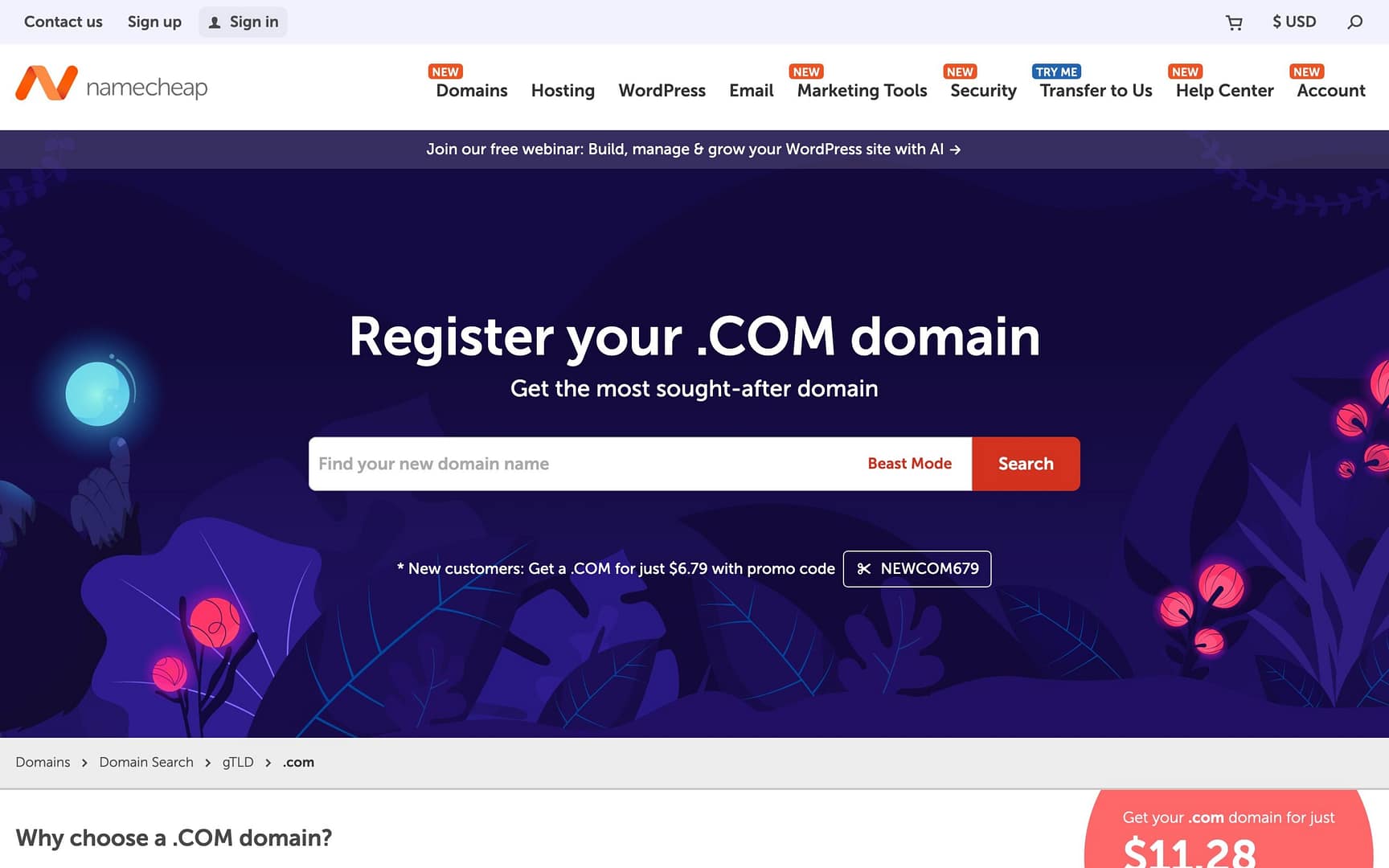
At Namecheap, a .com domain currently costs $11.28 for the first year (a 25% introductory discount off the regular $14.98) and renews at $18.48 per year, plus a mandatory $0.20 ICANN fee [3]. Most registrars cluster in the same neighborhood.
One dated change is worth knowing before you decide. Verisign, the company that operates the .com registry, has announced it will raise the wholesale price by 7%, from $10.26 to $10.97 per year, effective November 1, 2026 [4]. Registrars typically pass wholesale increases through, so expect retail .com prices to drift up accordingly. Verisign’s contract allows hikes of up to 7% in each of the last four years of its six-year contract cycle, which would take the wholesale price to $13.42 by the end of the cycle if it raises the maximum every year.
.ai
.ai plays in a different league. The registry requires a two-year minimum term, so your first invoice always covers two years at once. At Namecheap, .ai registration costs $79.98 per year with that two-year minimum, which works out to about $160 up front, and renewals run $114.98 per year [5].
The wholesale side moved recently, too. On March 1, 2026, the .ai registry raised its wholesale price from $70 to $80 per year, taking the mandatory two-year term from $140 to $160 [6]. Registrars add their own markup, and retail pricing varies widely: GoDaddy‘s regular .ai rate is $159.99 per year [7], noticeably above Namecheap’s renewal rate. Comparing registrars before you commit genuinely pays.

🏆 The verdict: .com
.com wins on cost, and it isn’t close. Even at full renewal price, five years of .com costs less than a single two-year .ai registration. The .ai premium can still be worth it for the right brand, but it’s a real budget line, especially for a bootstrapped business.
.ai vs .com: Name availability 🔎
Price is only half of the equation. The other half is whether the name you actually want is still available.
.com
With 161 million .com domains already registered, the odds of a short, obvious .com being available are slim. Most dictionary words, common name-plus-keyword combinations, and short acronyms were claimed years ago, and the attractive names that do surface tend to be premium listings or aftermarket sales with hefty price tags. You can absolutely still find a workable .com, but expect to add modifiers or get creative. And if you’d rather switch extensions than compromise on the name itself, our list of the best .com alternatives maps out the other credible options.
.ai
The .ai namespace is far younger and far less crowded. It crossed one million registrations in January 2026, so plenty of short, brandable names are still sitting there at standard pricing. If your business name is taken on .com, there’s a decent chance the .ai version is free.
Two caveats keep this honest. First, the best AI-flavored keywords are being claimed fast: the namespace grew from 598,007 registrations in January 2025 to over one million a year later [1], and our .ai domain statistics coverage tracks the boom in detail. Second, standard pricing only applies to standard names. Registries tag high-value keywords as premium, and premium names carry individually set prices that can run far above the regular rate.
🏆 The verdict: .ai
If you want a short, exact-match brand name, .ai gives you dramatically better odds than .com. Just check whether your chosen name carries premium pricing before you fall in love with it, and budget for the higher yearly cost either way.
Whichever extension you’re leaning toward, shortlist the name itself first. You can enter a few keywords into DomainWheel’s free AI-powered domain name generator, and it will suggest combinations and check availability automatically, so you can compare the .com and .ai versions of the same idea side by side.
.ai vs .com: Credibility and trust 🤝
Cost and availability are measurable. Credibility is about perception, and perception depends on who’s doing the perceiving.
.com
.com is the extension people expect. It has been the default for commercial websites for decades, so it reads as established rather than experimental, and visitors rarely give it a second thought. For audiences outside tech, think local customers, traditional industries, or less technical demographics, a .com address quietly answers the only question that matters: this is a real business.
.ai
Inside the tech world, .ai has genuine cachet. It tells visitors, investors, and potential hires that artificial intelligence is core to what you do, before they even reach your homepage. The extension’s growth has mirrored the AI boom itself.
Outside that world, the picture flips. To a non-technical customer, .ai can read as unfamiliar, or worse, as a typo for something else. And there’s a positioning trap: if AI isn’t actually central to your product, an .ai address overpromises. The cachet cuts both ways.
🏆 The verdict: Tie
This one genuinely depends on who’s looking. Selling to developers, investors, or early adopters? .ai signals that you’re part of the AI wave. Selling to everyone else? .com’s boring familiarity is worth more than any cachet.
.ai vs .com: Email, DNS, and SEO ⚙️
Now for the plumbing. The good news: this is the least dramatic dimension of the comparison, because both extensions are fully supported citizens of the domain name system (DNS), the system that translates names into the server addresses computers actually use.
.com
A .com works with every hosting provider, every email service, and every DNS configuration you’re ever likely to touch. It’s the zero-friction option: no explanations needed, no raised eyebrows, and no unusual-looking email addresses.
.ai
Technically, .ai behaves exactly like .com. It delegates in the global DNS like any other extension, works with any hosting or email provider, and supports standard security features like DNSSEC at Namecheap.
On the search side, Google has stated plainly that its systems treat newer extensions like the established ones, and that keywords in a TLD give no advantage or disadvantage in search [8]. Google also lists .ai among the country-code extensions it treats as generic [9], so an .ai site is not geotargeted to Anguilla and can compete globally just like a .com.
💡 In plain terms: choosing .ai won’t hurt your SEO, but it won’t help it either. Rankings come from your content and your links, and email deliverability comes from setting up authentication records properly, not from your extension.
One genuine practical difference: the two-year minimum means fewer renewals to manage, and less chance of an accidental lapse in any given year.
🏆 The verdict: Tie
Neither extension gives you a technical or search advantage. Set up your email authentication properly, keep your DNS with a reliable provider, and both will serve you identically.
.ai vs .com: Brand risk and resale 🛡️
A domain is a long-term asset, so the last dimension is what could go wrong over the years: price shocks, politics, and resale value.
.com
.com is about as stable as a digital asset gets. Its registry operator can only raise wholesale prices within contractual limits, currently 7% in certain contract years, and the extension isn’t tied to any single country’s politics or geography. The resale market is also the most established in the industry: if you ever sell your business or rebrand, a good .com is a liquid asset with decades of comparable sales behind it.
.ai
.ai is a country-code top-level domain (ccTLD), which means its fate is ultimately tied to a specific place: Anguilla, through the registry arrangement under which Identity Digital manages the namespace. That arrangement has been stable and hugely lucrative for the island, but the registry showed its pricing power when it announced a 14% wholesale increase in February 2026, effective March 5, 2026. Where .com’s increases follow a contract-capped schedule, .ai’s registry has shown it can move wholesale pricing on its own announcement.
For a cautionary tale about trendy ccTLDs, look at .io. That extension belongs to the British Indian Ocean Territory, and when the UK signed a treaty in May 2025 to transfer sovereignty of the Chagos Archipelago to Mauritius, the domain industry took notice [10]. ICANN has explained that if the territory’s code were removed from the ISO 3166-1 standard that underpins country-code domains, its retirement policy would apply, starting a five-year window in which the extension would be phased out [11]. The deal has since stalled and .io operates completely normally [12], so nothing has actually happened, and nothing in this story predicts trouble for .ai, whose situation is entirely different. It’s simply a reminder that every ccTLD carries a small geopolitical dependency that .com doesn’t have.
On resale, .ai’s aftermarket is real but young. The standout transaction so far is you.ai, which sold for $700,000 via Sedo, a public record for the extension at the time [13]. Sales like that prove demand exists, but the pool of comparable .ai sales is tiny next to .com’s.
🏆 The verdict: .com
.com carries less risk on every axis: capped price increases, no geopolitical dependency, and the deepest resale market. None of this makes .ai a dangerous choice, and Anguilla has every financial incentive to keep the namespace healthy, but long-term stability is .com’s home turf.
.ai vs .com: The verdict 📢
So which extension should you choose? Let’s recap the winners of each category:
- Cost: .com
- Name availability: .ai
- Credibility and trust: Tie
- Email, DNS, and SEO: Tie
- Brand risk and resale: .com
Overall, the two extensions are technically equivalent, separated mainly by price, availability, and audience. The right choice comes down to what you’re building:
Choose .ai if artificial intelligence is central to your product and your customers live in the tech world. The extension does real branding work there, and better availability means you can often secure your exact brand name. Just go in with open eyes about the two-year commitment and the higher renewals.
Choose .com if you’re building a broader business, selling to non-technical customers, or watching costs. It’s cheaper every single year, universally understood, and the safer long-term asset.
Leaning toward .ai? Our step-by-step guide to buying an .ai domain walks you through the whole registration process, from search to checkout.
References
[1] https://domainnamewire.com/2026/01/28/ai-namespace-hits-1-million-domain-names/
[2] https://domainnamewire.com/2026/02/05/verisign-reports-earnings-plans-future-product-launch-and-hints-at-price-increase/
[3] https://www.namecheap.com/domains/registration/gtld/com/
[4] https://domainnamewire.com/2026/04/23/breaking-verisign-raising-wholesale-com-prices/
[5] https://www.namecheap.com/domains/full-tld-list/
[6] https://domainnamewire.com/2026/02/02/ai-domain-name-prices-going-up-20/
[7] https://www.godaddy.com/tlds/ai-domain
[8] https://developers.google.com/search/blog/2015/07/googles-handling-of-new-top-level
[9] https://developers.google.com/search/docs/specialty/international/managing-multi-regional-sites
[10] https://domainincite.com/31086-io-questions-in-sharp-focus-as-uk-signs-chagos-treaty
[11] https://www.icann.org/en/blogs/details/the-chagos-archipelago-and-the-io-domain-14-11-2024-en
[12] https://domainincite.com/31642-io-safe-for-now-as-trump-puts-chagos-deal-on-ice
[13] https://domaininvesting.com/you-ai-sold-for-700000-via-sedo/